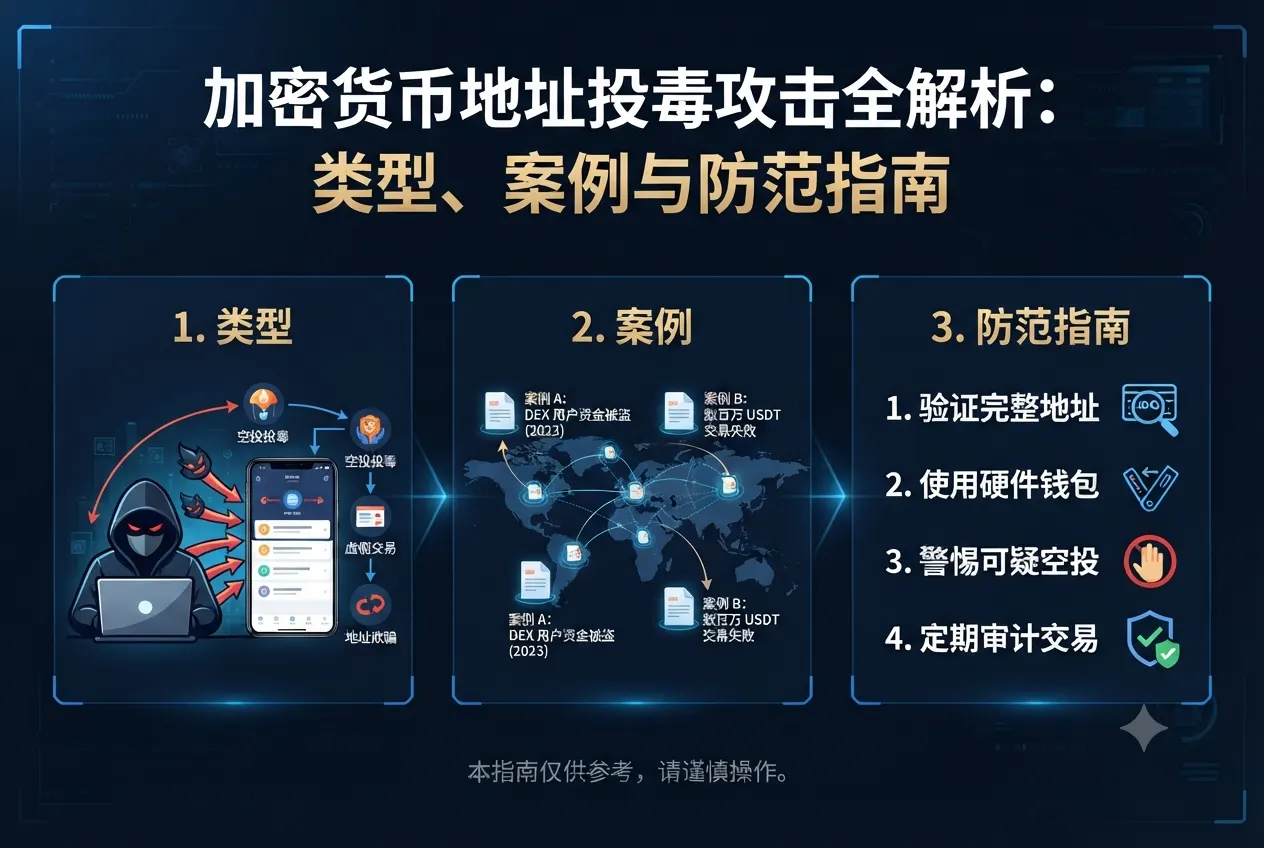
What Is a Crypto Address Poisoning Attack?
In the blockchain world, every transfer relies on a long string of letters and numbers: the wallet address. For ordinary users, memorizing these lengthy strings is nearly impossible, so copying and pasting becomes a habit. Attackers exploit exactly this human tendency — checking only the beginning and end while ignoring the middle — to launch scams known as address poisoning attacks.
The core logic of address poisoning is simple: an attacker sends a tiny transaction, sometimes even a zero-value token transfer, from a forged wallet that looks almost identical to an address the victim frequently interacts with. When that transaction appears in the victim’s wallet history, the unsuspecting user may copy that “familiar” address from the records the next time they make a transfer, sending funds straight into the hacker’s pocket. Note that the blockchain ledger itself is not tampered with; the attacker manipulates human attention and trust.
If the blockchain is an immutable public ledger, address poisoning is like splashing confusing ink spots onto its pages, causing the bookkeeper to misread them. This kind of attack requires no advanced code-cracking skills yet is extremely effective — it targets user laziness and visual blind spots directly.
Common Types of Address Poisoning Attacks: Beyond Look‑Alike Addresses
Many people think address poisoning simply means creating a similar-looking address, but the attacker’s toolkit is far richer. Understanding these techniques is essential to spotting the trap in critical moments.
Phishing: The Fake Entry Point
The most classic address poisoning often starts with phishing. Hackers set up fake websites that are almost 1:1 replicas of well‑known exchanges or wallet services, then lure users into logging in through emails, community DMs, or search engine ads. Once you enter your private key or seed phrase (the 12 to 24 words used to recover your wallet) on the fake site, the attacker gains full control of your wallet. Even more insidiously, they may not drain the funds immediately. Instead, they lie low, observe your transfer habits, and plant a poisoned address at the perfect moment.
Transaction Interception and Address Spoofing: Switching Targets Midway
If your device is infected with clipboard malware, every time you copy a wallet address, the malicious program silently swaps it for the attacker’s address in the background. This isn’t just a similarity issue — the destination is swapped outright. Another technique, address spoofing, relies more heavily on visual deception: hackers use specific algorithms to generate fake addresses whose first and last few characters are identical to your frequently used address. Amid a dense stream of characters, the human eye can barely spot the difference.
Fake QR Codes and Payment Addresses: Infiltrating the Physical World
Beyond online scenarios, attackers also print fake QR codes linked to malicious addresses, sticking them near crypto ATMs or even posing as promotional material from legitimate projects. The moment you scan the code, your wallet auto‑fills the attacker’s preset address. These attacks blend digital fraud into physical spaces, leaving offline users off guard.
Sybil Attacks and Smart Contract Manipulation
In decentralized finance (DeFi) protocols, attackers can pollute on‑chain governance or alter transaction sequencing by creating a large number of fake identity nodes — a Sybil attack. Address poisoning that exploits vulnerabilities in smart contracts can allow hackers to manipulate fund routing: you may approve a normal dApp interaction, only to later discover your tokens have flowed to an unknown malicious contract.
Zero‑Value Transfers: The Most Deceptive “Dust” Poisoning
A rapidly spreading tactic in recent years deserves special mention: zero‑value transfer attacks. This method uses a token contract’s transferFrom function to send a 0‑token transaction to your address without any private‑key signature from you. That transaction appears in your wallet history linked to a highly forged address. Because users tend to copy addresses from their history, zero‑value transfers have become a mass‑netting weapon for hackers. According to security researchers, over 270 million such attempts have occurred on Ethereum and BNB Chain alone, with cumulative confirmed losses reaching $83 million.
Real‑World Cases: No One Is Spared, from Individuals to Protocols
Address poisoning is not a theoretical attack on paper — it has already torn through countless asset lists. The following typical events show its destructive power.
May 2025: $2.6 Million in USDT Lost Twice by the Same Victim — A trader fell for a zero‑value transfer poisoning scam twice in quick succession. Trusting the spoofed address in his transaction history, he sent $2.6 million in Tether (USDT) to a hacker’s wallet. Post‑incident analysis revealed that the attacker had exploited the wallet interface’s display of transaction history to mislead the user’s copying behaviour.
May 2024: $68 Million in Wrapped Bitcoin (WBTC) Vanish — Possibly the largest single loss in address poisoning history. A whale user was tricked into sending 1,155 WBTC to a look‑alike address that differed by only a few characters from the legitimate one. The visual similarity of the address tail entirely fooled the victim, wiping out over 97% of the whale’s holdings in an instant.
March 2025: Attack Wave Following EOS Blockchain’s Rebrand to Vaulta — Right as the EOS network upgraded and rebranded, attackers used address names highly similar to those of major exchanges like Binance and OKX, casting small EOS transfer bait to trick users into mistaking them for official deposit addresses. This event highlighted how attackers ride the news cycle and exploit user trust in established brands with ease.
These cases all point to a brutal reality: whether you’re a retail investor or an institution, one careless copy‑and‑paste can wipe out years of accumulation. And as AI tools are increasingly used to generate highly similar addresses in bulk, the cost of launching such attacks is plummeting.
Why Is Address Poisoning So Hard to Defend Against?
Technically speaking, a blockchain address is essentially a random hash string — the human brain is just not designed to memorize and recognize such information. Modern wallet apps, to simplify the user experience, usually display only the first and last few characters, hiding most of the middle characters by default. This design creates a huge gap between convenience and security — attackers only need to match the beginning and ending characters to fool a user’s split‑second glance.
The deeper problem is the widespread habit of address reuse. Many users stick to the same wallet address for receiving or sending funds over long periods to save time, making their transaction history an open intelligence source that attackers can easily analyze. Once the usage pattern is mapped, the poison bait can be delivered with precision.
Moreover, blockchain immutability amplifies the loss. In traditional finance, you could call the bank to try to freeze a transfer, but on a decentralized ledger, once funds are confirmed, recovery is almost impossible. This means prevention must come first — there is no “undo” button.
How to Proactively Defend Against Address Poisoning
In the face of endless address poisoning variants, there is no single cure. You need a layered defense system to minimize the risk.
Generate a New Address for Every Transaction
Use a hierarchical deterministic wallet (HD wallet). It automatically creates a fresh address for each incoming payment, while all addresses remain under the control of a single seed phrase. This not only prevents pattern leakage from your transaction history but also deprives attackers of a clear target — because the poisoned address has no connection to the new one you use next. This eliminates the breeding ground for address poisoning at its root.
Hardware Wallet: An Offline Security Fortress
A hardware wallet keeps your private key completely isolated from the internet. Even if the connected computer is infected, transaction signing must be manually confirmed on the device’s small screen. It forces you to carefully verify every character of the recipient address on that screen, breaking the “one‑click copy‑paste” habit. For holders of significant assets, this should be a non‑negotiable baseline configuration.
Enable Whitelisting and Multisig
Many exchanges and on‑chain smart wallets support an address whitelist feature. You can predefine a set of trusted receiving addresses; any transfer to an address not on the whitelist will be blocked or delayed. It’s like putting a lock on your funds that allows only designated recipients. For organizations managing shared funds, a multisignature wallet (multisig) requires two or more independent devices to sign a transaction together. Even if one party is tricked, the funds cannot be moved unilaterally.
Leverage Blockchain Analytics Tools
Advanced users can automatically scan wallet histories with on‑chain analytics tools. These tools can flag valueless or zero‑amount “dust transactions” and alert you that you may be under a poisoning attempt. Some AI‑driven detection systems can even analyze address similarity and issue risk warnings. Although the barrier may feel slightly high for individual users, more and more wallet services are now building such security scoring directly into their interfaces.
Develop Robust Operating Habits
Beyond technology, human habit is the strongest firewall. Before every transfer, don’t just check the first and last characters — verify a few random character segments from the middle. Retrieve addresses from official sources or a saved address book rather than relying on transaction history. Be highly suspicious of any tiny token sent to you out of the blue asking for a “test transfer” — it is most likely a poisoning lure. Regularly update your wallet software to ensure clipboard access isn’t abused by malicious apps.
How Can the Community and Regulators Jointly Combat Address Poisoning?
Individual effort is crucial, but address poisoning as a systemic social‑engineering attack requires a coordinated ecosystem response. Security firms like Chainalysis have begun flagging and tracking clusters of known poisoning addresses, identifying over 82,000 malicious wallets involved in large‑scale campaigns. Wallet providers are also adjusting UI designs to warn users more prominently when they are sending to a new address for the first time.
Decentralization does not mean abandoning governance. On‑chain labelling of known malicious contracts, timely sharing of open‑source intelligence, and reporting major incidents to law enforcement all squeeze attackers’ room to maneuver. Even if losses cannot be fully reversed, filing a report provides data support for future tracking and legislation. Remember: when you stay silent, the scam gets one more round to live.
Conclusion: In the Trust Machine, Humans Are the Weakest Link
The blockchain is hailed as a “machine that creates trust,” but address poisoning attacks ruthlessly expose a truth: code‑level immutability alone cannot endow user behaviour with security. As long as transfers need to be initiated manually, the risks of visual blind spots and ingrained habits will always exist. That is why the key to crypto security isn’t relying on a single perfect technology, but building a defensive web where awareness, tools, and habits back each other up. The next time you are about to click “confirm transfer,” take five extra seconds to examine the address that will receive your assets — that may be the last line of defense protecting your digital wealth.
Comments 41
洛洛的eth
luo***4@163.comJul 15, 2026 20:07很多时候不是不懂,是急着转账就忽略了。希望钱包能加个强提醒弹窗:地址是首次交互!
Web3CodexOfficial
official@web3codex.ioJul 15, 2026 20:13非常好的UI改进思路,我们已将此建议反馈给合作的钱包团队,感谢您的贡献。
小寒EVM
274***6@qq.comJul 15, 2026 19:36剪贴板恶意软件那块,除了macOS和Windows,手机端是不是也高危?我经常手机转账。
Web3CodexOfficial
official@web3codex.ioJul 15, 2026 20:09手机端确实是重灾区,尤其安卓恶意输入法。建议只在官方钱包App内操作,关闭剪贴板跨应用读取权限。
Staking熊猫
pan***e@outlook.comJul 15, 2026 18:36硬件钱包那块,是不是Ledger和Trezor都支持文章里说的全址核对?想入手一个。
Web3CodexOfficial
official@web3codex.ioJul 15, 2026 19:01主流品牌均支持,强制在屏幕显示完整地址并需手动确认,尤其适合大额存储。推荐选购官方渠道。
风吟Web3
wi***t@hushmail.comJul 15, 2026 18:10既然AI能生成相似地址,那能不能用AI去预警这些地址呢?你们有这个方向的工具吗?
Web3CodexOfficial
official@web3codex.ioJul 15, 2026 19:33这正是我们在探索的方向,用对抗生成网络识别高仿地址。相关工具内测中,可联系客服加入白名单。
非典型极客
ge***t@protonmail.comJul 15, 2026 17:11物理攻击加二维码投毒,这个思路可以写个悬疑小说了。区块链安全真是攻防的艺术。
Web3CodexOfficial
official@web3codex.ioJul 15, 2026 17:40哈哈,确实像赛博朋克剧情。欢迎持续关注我们的安全科普,一起提高艺术鉴赏力😉
MerkleDance
mer***e@gmail.comJul 15, 2026 16:43对于DeFi协议开发者,有没有办法在合约层面过滤这些零值粉尘交易,比如通过事件监听?
Web3CodexOfficial
official@web3codex.ioJul 15, 2026 17:31合约端可通过require检查value或限制from地址,但零值可能绕过。更推荐前端监听+用户提醒结合。
MeshLabs
me***s@proton.meJul 15, 2026 15:38你们提到AI驱动检测相似度,是自研还是集成第三方?我们交易所想合作嵌入,能私聊吗?
Web3CodexOfficial
official@web3codex.ioJul 15, 2026 16:14我们提供API集成方案,欢迎垂询。请通过官网Telegram或邮箱联系我们,获取技术对接资料。
CloudOrch
clo***h@protonmail.chJul 15, 2026 14:41文章里说2.7亿次尝试,这数据太震撼了。想咨询下你们有没有企业级地址安全培训服务?💡
Web3CodexOfficial
official@web3codex.ioJul 15, 2026 15:26有的,我们提供定制化企业安全培训。可通过官网邮箱或Telegram联系商务,索取课程大纲。
数字游民阿飞
987***3@qq.comJul 15, 2026 13:39用了文章里推荐的方法,昨天刚躲过一次零值转账投毒,真的救了。谢谢!💪
Web3CodexOfficial
official@web3codex.ioJul 15, 2026 15:09您的分享让我们备受鼓舞,能帮到真实用户是最开心的。请继续保持良好的核对习惯!
HumbleYield
hum***d@gmail.comJul 15, 2026 13:07测试转一个币这种诱饵,我每个月能碰到两三次。幸好习惯不好,从来不理,反而因祸得福😂
Web3CodexOfficial
official@web3codex.ioJul 15, 2026 13:57您的“坏习惯”反而成了护身符。持续忽视小额粉尘确实是有效的被动防御。
VaultVan
va***n@protonmail.comJul 15, 2026 12:40我们那个DAO最近因为复制错地址丢了一笔国库款,太痛了。多签确实应该强制执行。
Web3CodexOfficial
official@web3codex.ioJul 15, 2026 12:56DAO资金安全至关重要,多签+时间锁+白名单是铁三角。如有需要,可咨询我们团队定制安全方案。
大橙子🍊
bigo***o@yahoo.comJul 15, 2026 12:08那个假二维码放在ATM旁边,线下更难防啊,以后扫码前得用链上工具扫一下。
CyberPiggy
cyb***y@tutanota.comJul 15, 2026 10:08我之前被这种假地址骗过0.5ETH,事后才知道要核对中间段。有没有小白也能用的检查工具推荐?
Web3CodexOfficial
official@web3codex.ioJul 15, 2026 11:35很心疼您的经历。像Rabby、Zerion等钱包已内置风险评估,硬件钱包也强制全址核对,建议逐步升级。
L2探索者
l2_***r@protonmail.comJul 15, 2026 09:09文章写得很系统,已加入收藏夹,希望多更这类安全干货!
深海巨鲸
wha***p@163.comJul 15, 2026 08:40260万U的二次受害,中间他竟然没检查?这说明现在的钱包UI也有责任,只显示首尾位太坑。
Web3CodexOfficial
official@web3codex.ioJul 15, 2026 09:23您说到了痛点,UI设计需要在简洁和安全间平衡。我们也在推动钱包方提供中间位预览的选项。
OldFarmer
275***0@qq.comJul 15, 2026 00:59那笔6800万WBTC的故事太吓人了,就几个字符差别,可能毁掉一辈子积累。
雪鸮Sec
sno***c@proton.meJul 15, 2026 00:25Sybil攻击和地址投毒结合的那个点有意思,想了解在治理场景下的具体攻击向量,能展开吗?
Web3CodexOfficial
official@web3codex.ioJul 15, 2026 08:43感谢关注,Sybil+投毒常污染投票权重。后续我们会出深度报告,您可订阅官网安全专栏等更新。
链上蜗牛
sna***n@163.comJul 14, 2026 23:23EOS那个改名攻击真的紧跟热点,黑客太会挑时机了 😂
区块守卫
379***7@qq.comJul 14, 2026 22:58免费的安全工具推荐下?最好开源的那种,可以自己二次开发集成到产品里。
Web3CodexOfficial
official@web3codex.ioJul 15, 2026 00:12推荐GoPlus、BlockSec等开源API,部分提供地址风险标签。如需更深集成,欢迎从官网联系我们。
CryptoMia
mia***o@outlook.comJul 14, 2026 22:28看了这个背脊发凉,以前还真从交易记录里复制过地址 😨 感谢科普!
AdaBuild
ad***d@proton.meJul 14, 2026 21:27我们团队打算做多签钱包业务,能咨询一下集成地址检测工具吗?可以联系你们吗?
Web3CodexOfficial
official@web3codex.ioJul 14, 2026 21:57很高兴您感兴趣,多签集成安全检测是很好的方向。您可通过官网Telegram或右侧客服按钮立即联系我们团队。
RubyOnRails
ru***i@gmail.comJul 14, 2026 20:24测试转账那招确实阴险,现在看到来历不明的小额币都直接隐藏了 🔥
LeoW3b
l***b@gmail.comJul 14, 2026 19:51零值转账攻击那段干货很多,不过用HD钱包每次生成新地址,在交易所提现时好像不太方便?
Web3CodexOfficial
official@web3codex.ioJul 14, 2026 20:05您的观察很准,交易所提现通常要求绑定固定地址,建议采用白名单+硬件钱包双重验证,可大大降低风险。
NovaChain
nov***n@fastmail.comJul 14, 2026 19:21好文,已经转发给团队,打算把白名单流程加到公司安全手册里 👍